Deck rot rarely announces itself. It starts as a board that feels slightly soft near the steps, a dark patch by a post, or a screw that no longer bites. In Lincolnton, where summer storms soak decks weekly and shade keeps them damp, soft wood spreads quietly along a board and into its neighbors, and a problem that was one board in spring can be a section by fall.
Troubleshooting a deck is a walk with a screwdriver. Start from the symptom you noticed, test the wood around it, and let what you find decide the scope: a board replacement, or a structural look from a pro.
Start with the symptom
A spongy feeling underfoot means the wood fibers in that spot have lost their structure to decay fungi, which need moisture, warmth, and time, all of which a Carolina deck supplies. A board that rocks or flexes differently from its neighbors may be rotted at a joist contact point rather than in the middle. Raised, cupped, or splitting boards are often just weathered, which is cosmetic, while softness is always structural information.
Use the pick test. Press an awl or a flat screwdriver into the wood at the suspect spot and at a sound board for comparison. Sound wood resists and lifts in long splinters when pried. Rotten wood lets the tool sink in and lifts out in short, crumbly chunks. Test at board ends, around fastener holes, and anywhere water sits, since those are the places decay starts first.
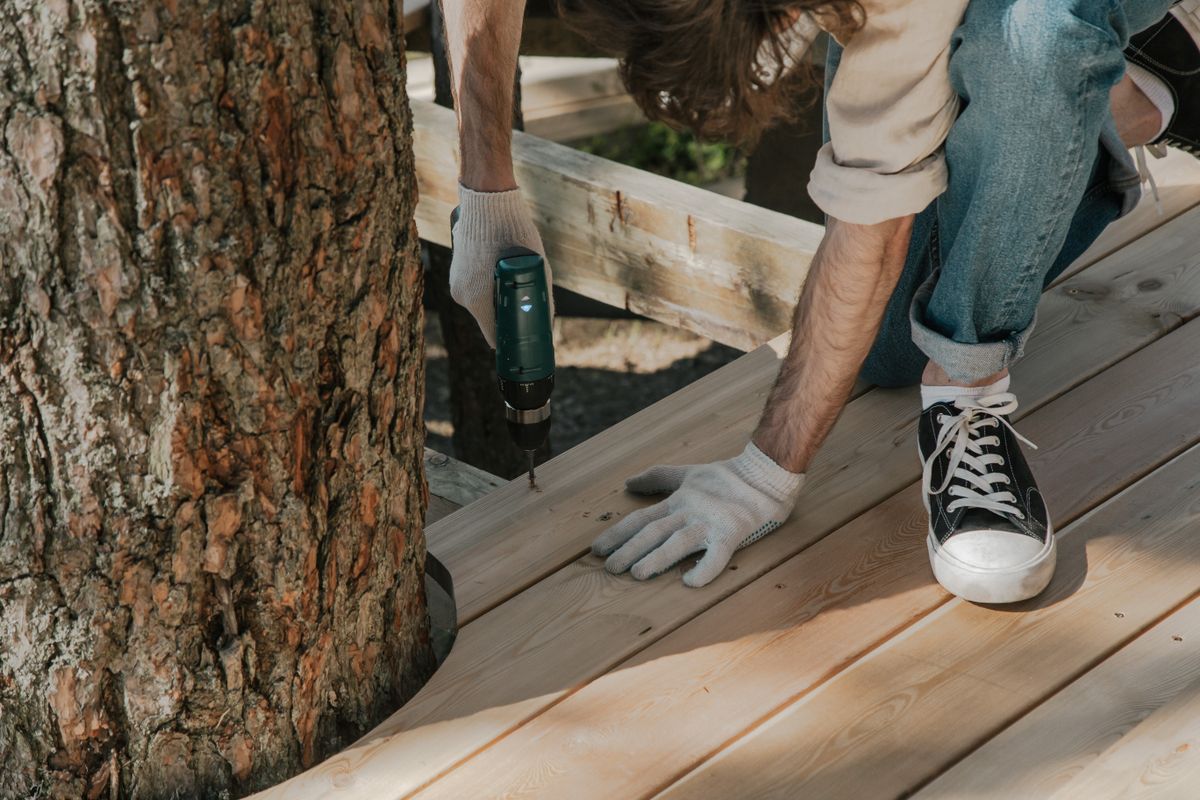
- Walk and bounce-test the whole deck. Cover every board, paying attention near steps, posts, planters, and the house wall. Mark soft spots with chalk as you find them.
- Pick-test each marked spot and its neighbors. Rot does not respect board boundaries. Test a foot in each direction from a soft spot to find where sound wood starts again.
- Look underneath before deciding. From below, check the joists under the bad boards and the ledger board where the deck meets the house. Surface rot over sound joists is a board job; soft joists are a bigger conversation.
- Check the ledger flashing. The metal or membrane flashing over the ledger keeps house-wall water out of the connection. Missing, bent, or buried flashing is the most consequential deck defect there is, because ledger failure is how decks pull away from houses.
- Remove bad boards fully, not partially. Pull the whole board between its supports. Splicing a short section into the middle of a span leaves weak joints and mismatched wear.
- Match the replacement properly. Use the same nominal size and a compatible species and treatment level, set the crown up, and leave the standard small gap for drainage. End grain is the thirstiest part, so sealing fresh cuts helps the new board start even with the old ones.
- Fix the water source. A clogged gutter dripping on one corner, a downspout aimed at the deck, or soil built up against the rim will rot the new board on the same schedule as the old one.
Board matching and the honest mismatch
A new pressure-treated board will not match a weathered deck on day one. New lumber arrives greener and often wetter, and it weathers toward gray over a season or two. Staining the whole deck after repairs evens the look faster than trying to stain one board to match. If several boards in the main field are near the end together, replacing them in one visit beats a checkerboard of single boards replaced a year apart, in both appearance and effort.
When the walk says call a pro
Stop at boards and call for help if the pick sinks into joists, posts, or the ledger, if the deck moves or sways when several people stand on it, or if posts show softness at ground level where they meet the soil. Deck and porch repair is among the services listed by Bullock Home Repair, and structural members are the clear professional side of this line.
Keep notes on which boards you replaced and when. A simple dated list, kept with the house records, turns the next inspection from guesswork into a quick comparison against last time.
Common questions
Can I just flip a rotting board over?
Flipping hides the damage without removing it, and the decay continues on the underside where it now sits against the joist. Replace boards that fail the pick test.
How long should pressure-treated deck boards last?
Modern treated boards commonly serve fifteen years or more, with the wide range driven by shade, drainage, and maintenance. Boards in constant damp fail much sooner.
Is a dark stain on a board always rot?
No. Mildew and dirt darken sound wood and wash off. The pick test, not the color, tells you whether the wood itself has gone soft.
Photos in this guide are representative stock images.
← All guides from Bullock Home Repair← Back to Bullock Home Repair